
Document 2.1-3b
FLUOR-O-FLO® PTFE NPT Piping System
Pressure Ratings for PTFE Schedule 80 Pipe and NPT Pipe Fittings
Copyright 2007, Revision Date: Aug. 2015
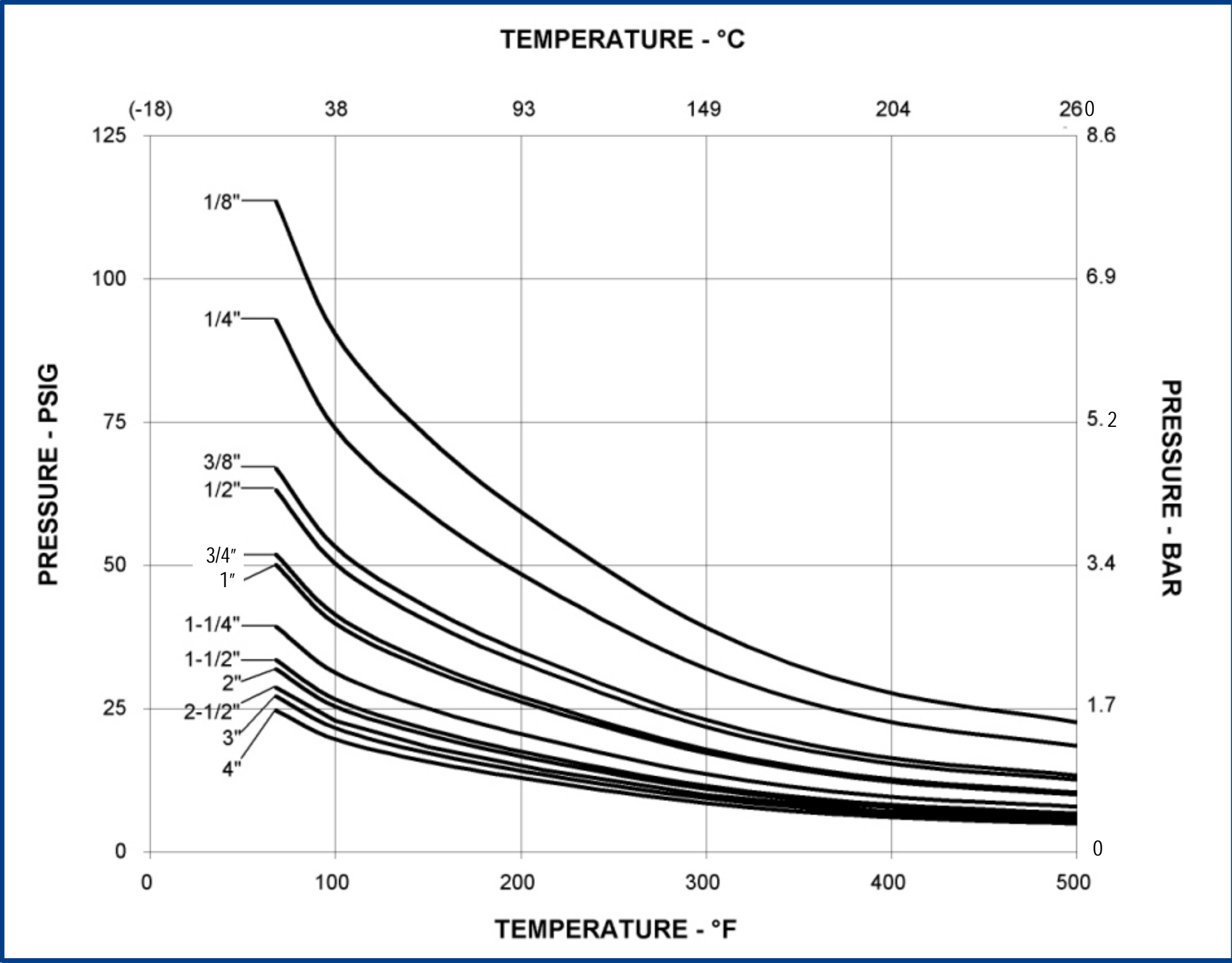
When subjected to long-term stress, PTFE has a tendency to creep (“cold flow”). For that reason, PTFE pipe is recommended for use only in relatively low pressure applications. To provide designers with guidelines for suitable use we have prepared the long-term continuous service pressure ratings shown in the chart above. The process we used to develop these ratings is summarized on the reverse side.
It should be noted that pressures considerably higher than those shown in the chart can be handled for short periods. Also, considerably higher pressures can be handled at lower temperatures. These service conditions are discussed on the reverse side.
Because individual service conditions vary, and because we have no control over individual applications and installations, we can not guarantee the ratings in particular use. It is up to the user to determine suitability for a specific application.
For hazardous service conditions, we strongly recommend that the user de-rate the system. For unusual or demanding applications, we recommend and encourage the user to contact the factory.
Long-Term Continuous Service Pressure Ratings
The pressure ratings in the chart were calculated using Barlow’s formula as found in ASTM D2837 and in ISO R161:
The rating formula requires use of an Allowable Hoop Stress for the pipe material. We developed values for Allowable Hoop Stress of PTFE using procedures similar to those outlined in ASTM D2837, “Obtaining Hydrostatic Design Basis for Thermoplastic Pipe Materials”:
- First, we developed values for Hydrostatic Design Stress which produce a 5% deformation in the PTFE in 100,000 hours. They were developed by:
- Extrapolating to 100,000 hours a log-log plot of test data published by PTFE resin suppliers for tensile stresses which produce 5% strain in 0 to 1,000 hours plus. These data are available from more than one resin manufacturer for temperatures of 20°C, 100°C, and 200°C. The most conservative values from the published data were used.
- Interpolating these data to provide values for other temperatures in the desired range from room temperature to 500°F.
- Then, we applied a safety factor of 2.5 (minimum) to derive values for the Hydrostatic Design Basis.
We believe these values for the Hydrostatic Design Basis are reasonable values to use for the Allowable Hoop Stress in Barlow’s formula to determine long-term continuous service pressure ratings for the FLUOR-O-FLO® PTFE NPT piping system.
Other Service Conditions
Short-Term Surge Pressures
Because in the short-term, creep is much less a factor for PTFE than in the long-term, PTFE is capable of withstanding far higher short-term than long-term stress. Thus, the FLUOR-O-FLO® PTFE NPT piping system is capable of handling considerably higher short-term surge pressures than the long-term continuous pressure ratings in the chart.
Low Temperature Applications
PTFE creeps far less at low temperatures than at high temperatures. As a result, over the long-term, the FLUOR-O-FLO® PTFE NPT piping system can handle much higher pressures at conditions below room temperature than at the temperatures rated in the chart.
Barlow’s formula
For more information on these or other special service conditions, please contact factory.